Tube pressure
100Pa
The reference design assumed about one-thousandth of atmospheric pressure. A host would measure how much power it takes to reach and hold that level.
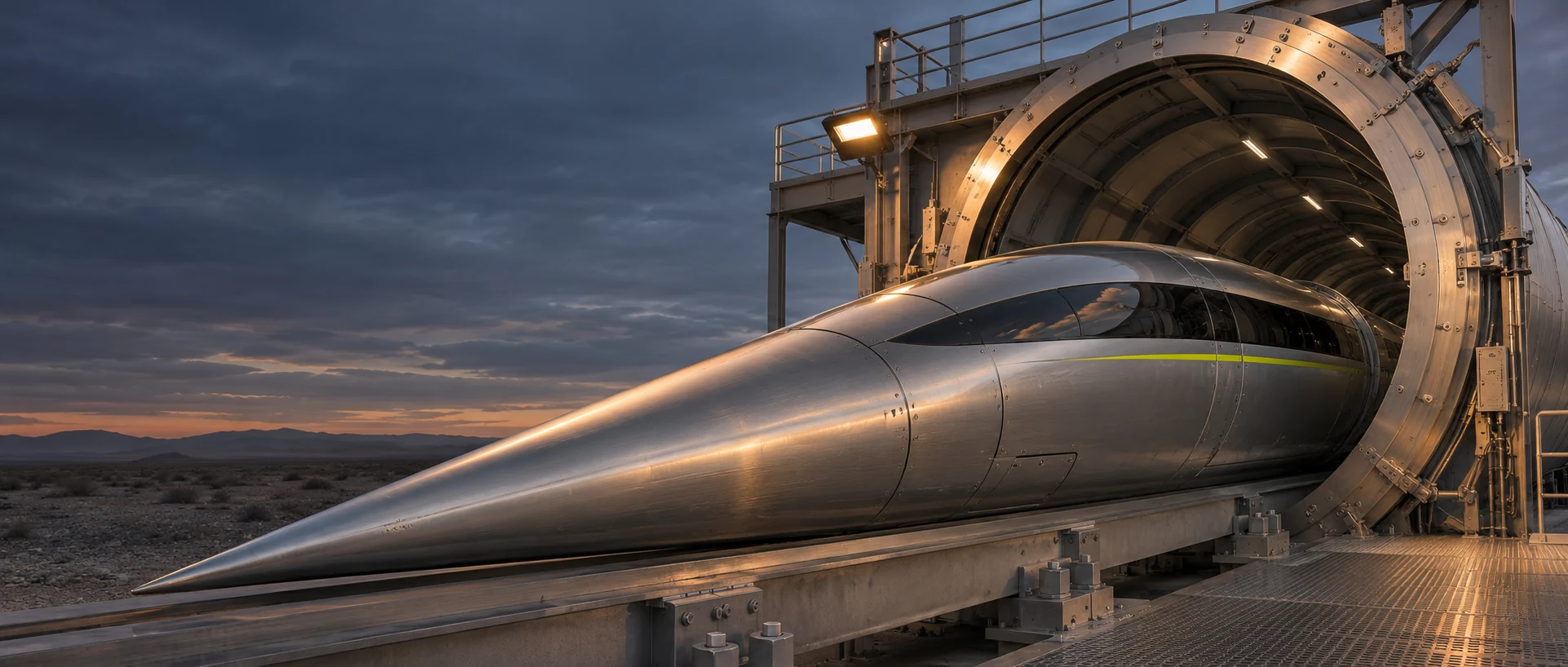
Host country programme
What is an hour worth?
We invite governments to host a closed test track. The question is how much time a low-pressure transport system could give back on a journey between cities.
Journey Reincarnated
A two-hour round trip, twice a week, adds up to 200 hours over a 50-week year.
Business moves across time zones. People still spend hours reaching the next city. For a commuter, a clinician or a parent, cutting even part of that journey changes what fits into a day.
Hyperloop Alpha proposes a closed research track to test the vehicle, measure energy use and practise recovery. The eventual test for a passenger route is time saved door to door, including the wait at each station.
Try a journey scenarioThe reference design
In a narrow tube, a fast capsule pushes a column of air ahead of it. An early design proposed drawing air through the nose, routing some behind the vehicle and feeding air bearings beneath it. Linear electric motors along the track would supply thrust.
100Pa
The reference design assumed about one-thousandth of atmospheric pressure. A host would measure how much power it takes to reach and hold that level.
28seats
The reference cabin accommodated 28 people. Alpha’s first proposed pod would carry instruments to record what happens on each run.
1,220km/h
A modelled peak on favourable sections of one corridor. Track length, curves and braking margins determine the speed an experiment can investigate.
These figures describe a design study. Alpha’s proposed track would begin with uncrewed tests. Read the technical whitepaper
Proposed test track
Explore the equipment, the question it would answer and the evidence a host authority could review.
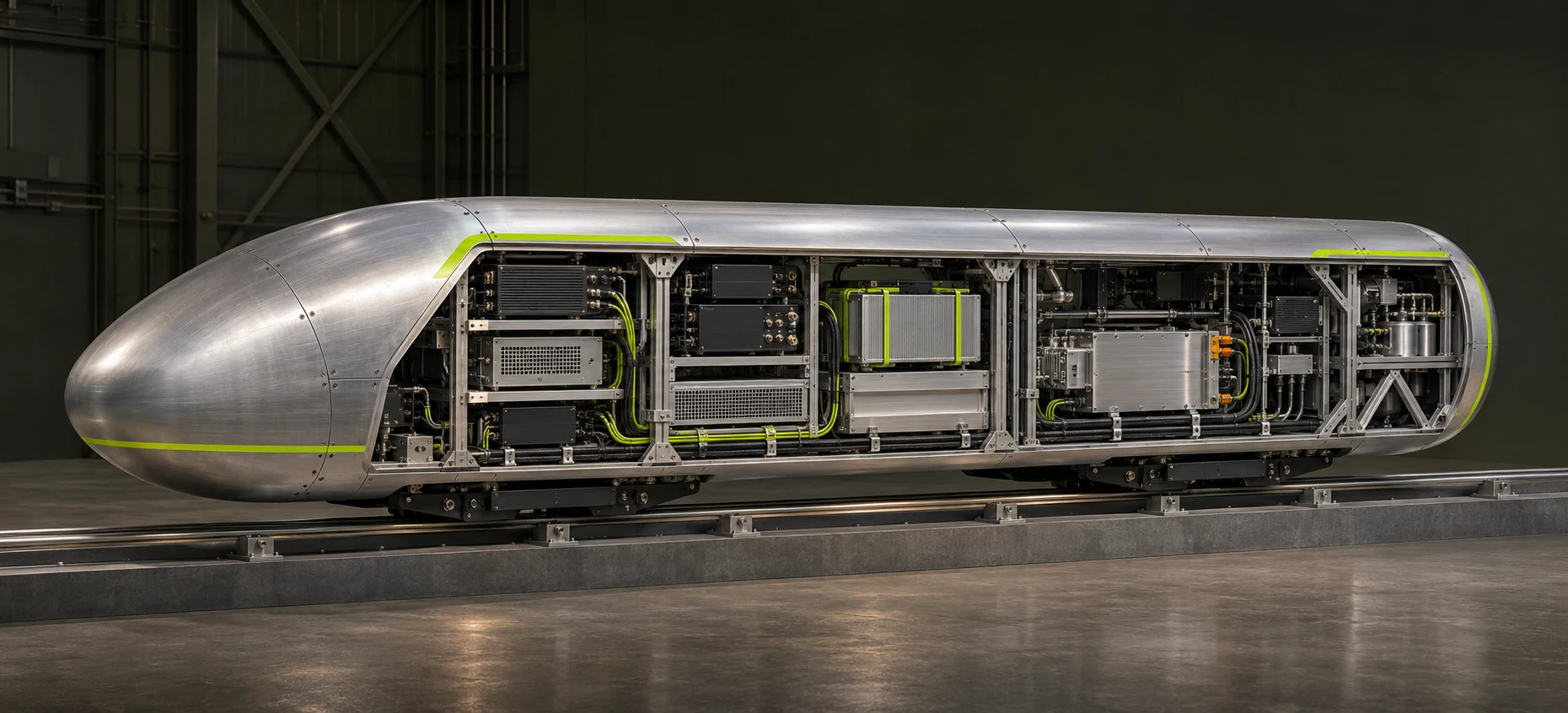
An uncrewed vehicle would carry sensors and a common clock. Linking its position to power, vibration and temperature lets a reviewer trace an unusual reading to a particular place on the track.
Proposed test recordTime-aligned run log, sensor calibration record and repeat-run comparison.
Journey model
Choose a distance and test two assumptions. How much faster must the ride be to justify the extra time spent getting through a terminal?
Illustrative inputs. A future route would need measured speeds and local station access times.
One-way difference
65 minless time door to doorBoth journeys cover the same distance. The reference assumes a 150 km/h average and 30 minutes combined for access, waiting and exit. Ride time in minutes equals distance divided by average speed, multiplied by 60. Average speed includes acceleration, stops and braking. The display rounds to the nearest minute.
These inputs illustrate the trade-off. Hyperloop Alpha has yet to establish a route, operating speed or timetable.
Independent research
Three facilities show what different track lengths can teach us. Each result belongs to the organisation named below.
Ottobrunn, Germany
Test segment length
2023
TUM reports that passengers travelled in its full-scale demonstrator under vacuum in July 2023. The result concerns this experimental segment.
TUM test reportToulouse, France
Test segment length
2018–2024
HyperloopTT reports bringing its full-scale tube below 10 Pa. Its programme also examined leaks, pumping energy and control systems.
HyperloopTT facility recordVeendam, Netherlands
Test segment length
2024
The centre opened a test tube with a full lane switch. The layout lets researchers investigate how a vehicle can move between branches.
Centre announcementTwo published feasibility studies illustrate the public decisions that come before a route.
In a June 2019 memorandum, the Northeast Ohio Areawide Coordinating Agency recorded a US$1.2 million feasibility study with costs split equally between the agency and HyperloopTT. Its scope covered route reconnaissance, engineering, financial viability and development costs.
For a prospective host, the first financing decision is what the study should settle and which party pays for each part.
Read the agency memorandumIn 2025, HyperloopTT, EGA Group and the Federal University of Santa Catarina reported a freight study covering a proposed 549 km corridor from the Port of Santos into the São Paulo hinterland.
A host examining freight would need to compare container handling, terminal queues and onward delivery with today’s port-to-inland journey.
Read the study announcementThe European Commission’s 2025 assessment identifies capital cost, regulation and the commercial case as open questions for the sector. Read the assessment
Hyperloop Alpha publications
Read the engineering case, share the programme with colleagues or take the host invitation to your ministry.
The case for giving travellers an hour back, and the first experiments that could tell us whether it is possible.
PDFThe angular H, the wordmark and their use across public communications, technical figures and government correspondence.
PDFTube pressure, vehicle dynamics, braking distance and the cost of keeping a facility ready between runs. Includes worked examples.
PDFA formal invitation for a ministry or transport authority to explore a host site and nominate a technical contact.
PDFFor governments
A ministry, regional government or public agency can open the discussion. A named point of contact is enough to begin.
Download the interest letter PDFTell us who would lead an exploratory discussion and which transport priorities matter in your region.
If you have a site in mind, we would discuss land control, geometry, utilities and emergency access with your technical counterparts.
Identify the evidence, permissions, cost responsibilities and decision points both sides would need before any construction proposal.
The proposed scope gives a ministry four deliverables for its next investment decision. The parties would agree responsibilities, budget and access to the results before commissioning work.
Government enquiries
National ministries, regional governments, transport authorities and public development agencies may register. Please identify the public body you represent and provide a professional contact.
You can request a briefing before identifying a site. If you already have a candidate, its approximate location and a short description are enough for a first conversation.
It opens a discussion. Funding, land access, procurement, permissions and construction would each require separate decisions by the relevant authorities.
Hyperloop Alpha is an independent host-country initiative. We are inviting public authorities to define the scope of an uncrewed test programme. A host site, construction budget and test timetable would each need separate agreements.
The host and engineering team would choose a length after agreeing the tests. A segment suited to pressure and access trials may provide too little room for acceleration, controlled braking and a margin at each end. Those requirements would form part of site selection.
The initial proposal centres on uncrewed trials. A host with a port or logistics corridor could also propose a freight study. That work would need shipment volumes, handling times at both terminals and a comparison with the existing road or rail service.
The current invitation outlines a research scope and the evidence a host could request. Site selection, the capital budget, technical appointments and any construction timetable would require documented agreements. A government can request a briefing before nominating land.